

Stay curious.
It’s the opposite of fear. And it’s something we all need oodles of.

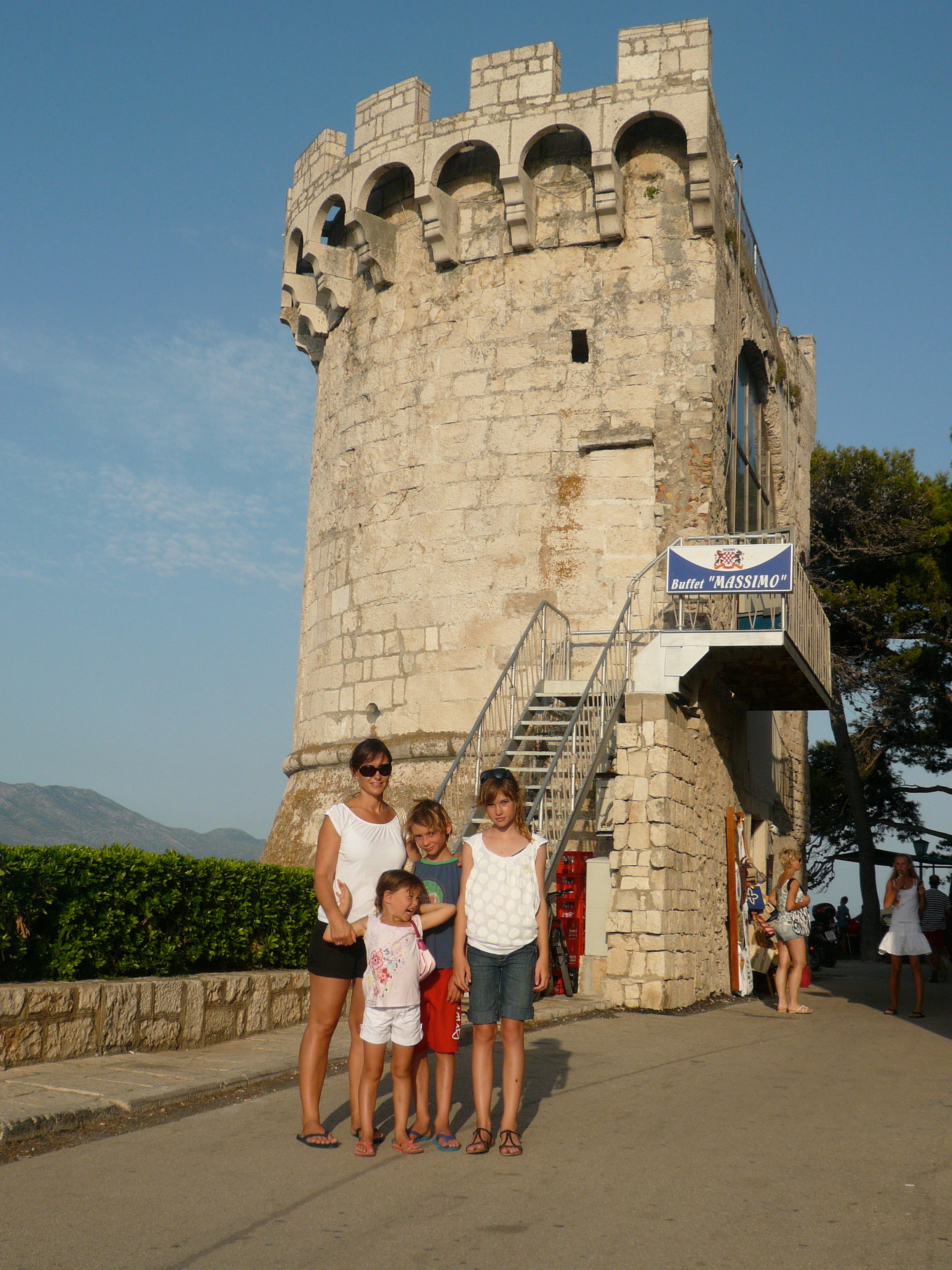
We were here 18 years ago.
Different boat. Different crew. Same water, same islands, same light falling at the end of the long Adriatic afternoons on the same ancient stone.
The Dalmatian Coast.
In 2008, Jo and I chartered a Beneteau 423 out of Dubrovnik and pointed her north. Miki was 12. Ethan was 8. Avalon was 6. We loaded them aboard, cast off, and went — because that’s what you do when you’ve decided that curiosity is more useful than caution.
We didn’t know we were teaching them anything.
We were just sailing.


This kind of sailing is nothing like racing.
I grew up racing — dinghies on inland waterways, then up and down the Australian east coast, competing in state and national championships. Racing is fast, physical, tactical, and entirely focused on the boats directly ahead and the ones just behind. The horizon is irrelevant. What matters is the mark, the layline, the shift, the gap, the competition.
Cruising is the opposite of all that.
The horizon is everything. The mark is wherever you decide to anchor tonight. The shift is interesting rather than urgent. And the boat you’re most aware of is the one sailing alongside you — in our case, Dash, with Steven and Kristy aboard, fellow Australians and fellow curious types who have become our closest companions on this journey north through Croatia.
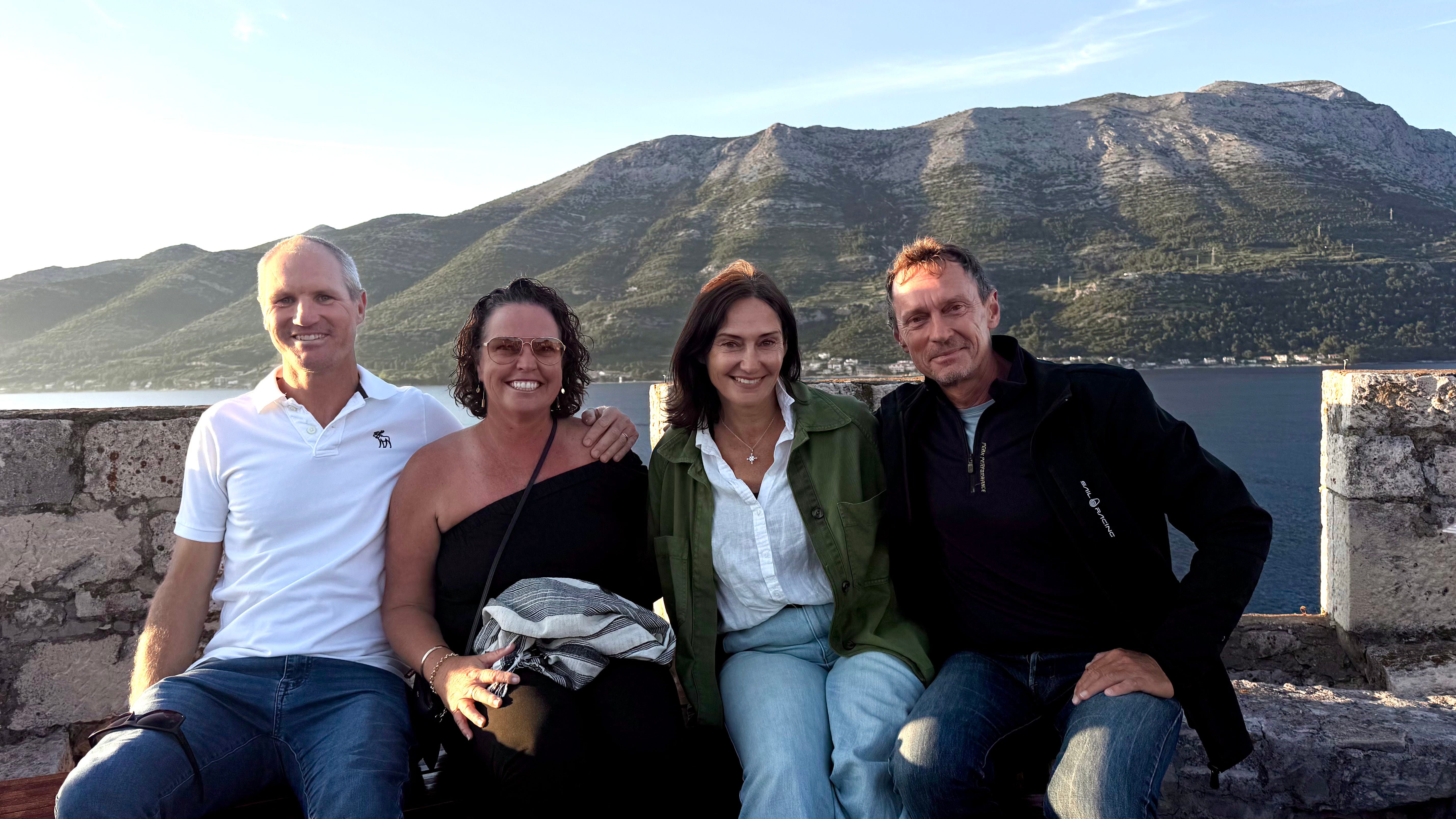


We’ve been rock-hopping up the Dalmatian Coast together, north from Dubrovnik. Cajkovici, Uvala Spilice, Polače on the edge of Mljet National Park, Korčula, Lovište at the tip of Pelješac, the tiny island of Šćedro, and Gradina back on Korčula to hide away from rough weather for a few days.
Along the way we’ve been joined by Nigel and Amanda on Kerensa — English yachties, who sailed here from Tunisia, which immediately makes them interesting — and Nick and Lee, an Australian and New Zealander respectively, converging on us from somewhere to the south.
All of them warm-hearted, well-travelled, and curious to a fault. People who chose this life with their eyes open.
Croatia in April-May is a different country from Croatia in July.
In July, it’s like the raft of boats across Sydney Harbour on New Year’s Eve — every boat in service, every quay heaving, every anchorage a negotiation you’ll probably lose. In April, the season hasn’t started, the restaurants are mostly closed, and the places that are chaotic and expensive in three months are quiet, uncrowded, and in several cases entirely ours.
After our first night — €53 on the town quay in Cavtat, fair price for a port of entry with friendly border police and an immaculate harbourmaster — we haven’t spent a penny to tie up or anchor. Not even in Polače, one of the Adriatic’s most celebrated anchorages, where we rode e-bikes around Mjletet National Park and visited the Benedictine monastery on the lake.
On Šćedro, one of Croatia’s tiniest islands, we played Finska on the beach and read books. On Lovište we walked, swam briefly and painfully — double-duvet weather, with swims that leave you tingling and genuinely unsure whether that was electrifying or painful — and drank bottled Ožujsko in the only bar open. There must be twenty bars on that waterfront in summer. In April, just the one, and it was perfect.
Pomalo, as the Croatians say. Roughly: take it easy. They’ve been practising for centuries, and they’re very good at it.
Come early. Come late. Whatever you do, don’t come when everyone else does.
Three rabbit holes to explore
One.
The Dalmatian coast has been producing wine for over 2,500 years. The steep limestone slopes of the Pelješac peninsula — which we sailed past on our way north — grow Plavac Mali, Croatia’s most celebrated red grape and, as it turns out, the genetic parent of Zinfandel. Nobody told California.
"Holy sh**, that's good!", said Anthony Bourdain. While visiting the Bibich winery in Croatia, Bourdain was so taken with the local wine (including Plavac Mali, a relative of Zinfandel) that he famously said, "Why, oh why, is there so much amazing wine in this country?"
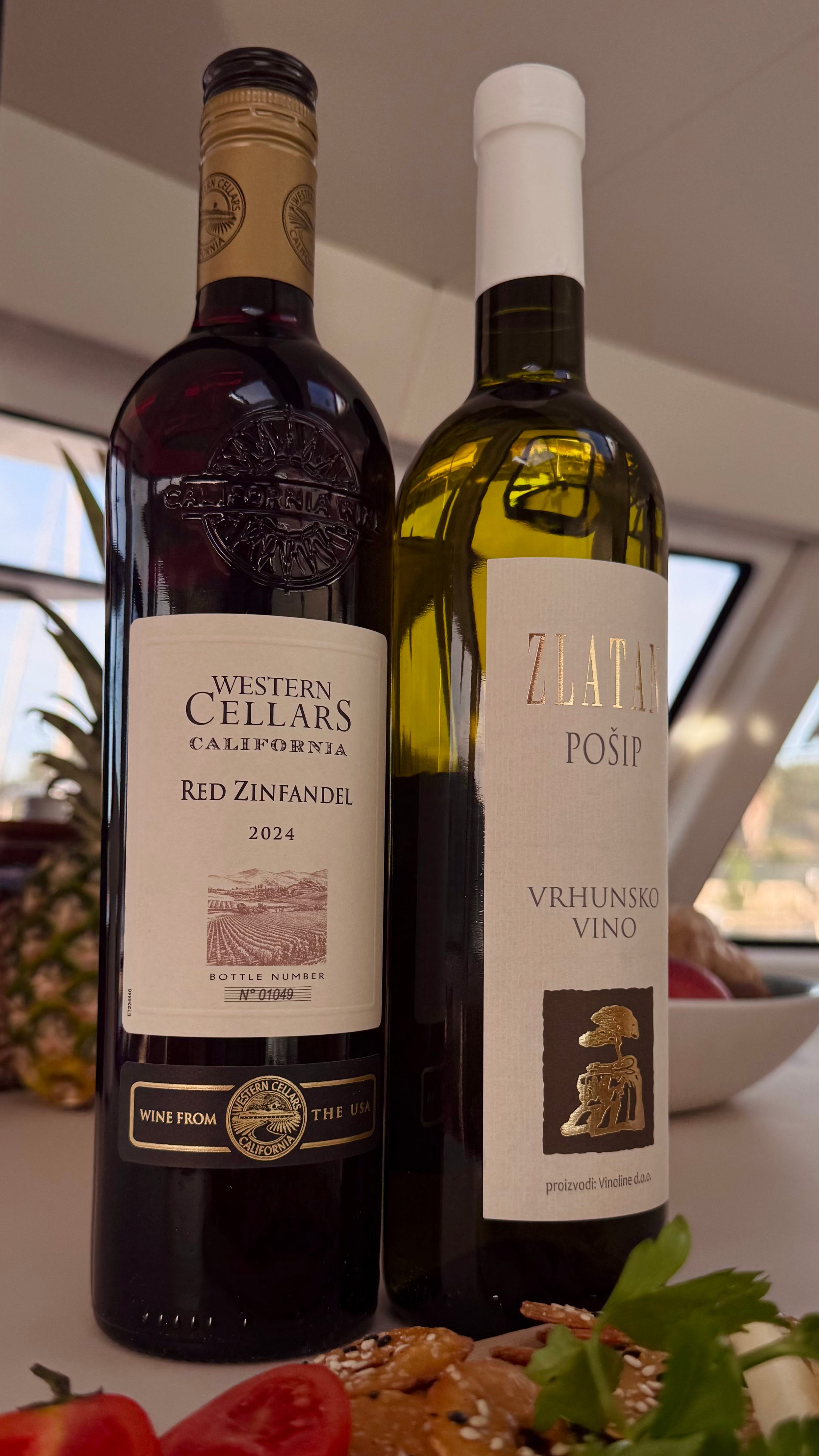
On Korčula, the white grape is Pošip — crisp, citrusy, mineral, and best consumed at anchor in the late afternoon with something that recently came out of the sea.
We have been conducting extensive research. It’s a hardship posting.
Two.
I like to quaff my Pošip while wearing a cravat.
The necktie was invented here. In the 17th century, Croatian mercenaries wore distinctive scarves that caught the eye of King Louis XIII of France, who made them a royal fashion requirement. The word “cravat” comes from “Croat.” Every schoolboy who has ever wrestled with a Windsor knot on a Monday morning has Croatia to thank.
Three.
Legend has it that Odysseus himself was shipwrecked on Mjlet — the island we’ve just left — where he spent seven years captivated by the nymph Calypso in a sea cave on the southern coast. The cave is still there, accessible by swimming through a narrow tunnel.
Seven years in a cave.
She must have been something.
Korčula stopped us both in our tracks
The old town sits on the tip of a long, forested island — medieval walls, honey-coloured stone, and lanes narrow enough to touch both sides simultaneously. Marco Polo was allegedly born here, a fact the town mentions with admirable restraint, roughly every thirty metres.
Odysseus and Marco Polo in the same neighbourhood? Just imagine.
We have a photograph from 2008, the one at the top of the page. Jo and the three kids on the waterfront stairs below Massimo — a cocktail bar perched on top of one of the old city’s defensive towers, drinks delivered by pulley, objectively the best bar in the world. Miki tall and twelve. Ethan grinning the grin he still grins. Avalon at six, standing the way six-year-olds stand when they’re not yet aware of cameras — completely, entirely themselves.
Jo and I stood by those same stairs last week.
The stone hasn’t changed. It’s been there since the 14th century and has seen considerably more than us.
Jo looked at the photo on her phone, then at the stairs, then back at the photo.
“Cute family,” she said.
And that was that.
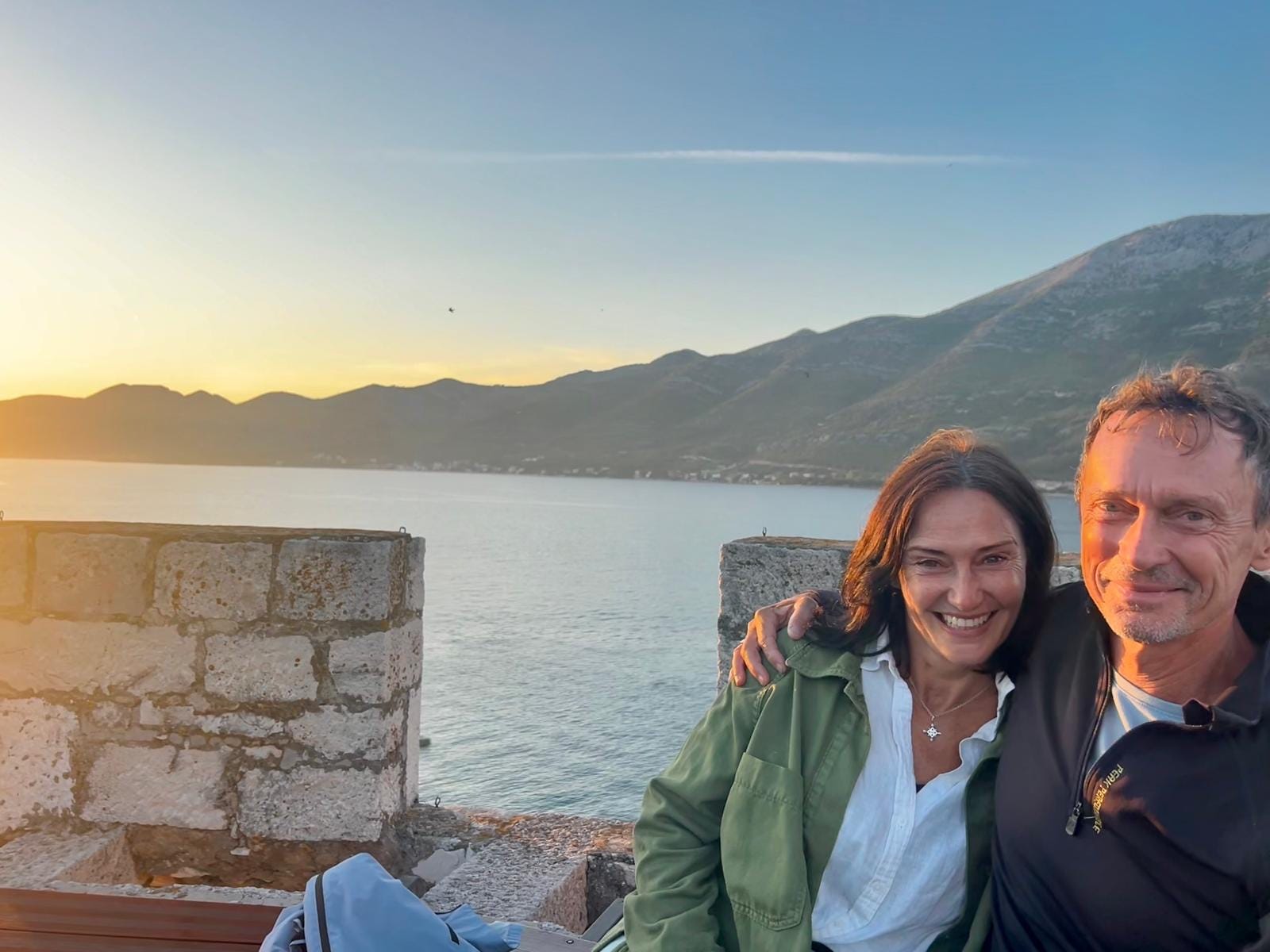
When I worked in advertising, I used to tell creative people: Stay curious. Never think you know it all. Stay open. Be hungry to learn. Be humble. Be happy to know that the best idea in the room might not be yours.
It turns out this is equally good advice for life aboard a boat.
Someone — it’s been attributed to both Ellen Parr and Dorothy Parker, and the true origin is pleasingly unresolved — once said: the cure for boredom is curiosity. There is no cure for curiosity. I’ve been thinking about that a lot since we arrived in Croatia.
Sailing serves the curious in concentrated form — navigation, weather, history, culture, language, mechanics, marine biology, and the particular behaviour of the wind as it bends around an island at dusk. Every anchorage is a classroom. Every passage has something to teach. Every salty nutter in every boatyard has a story that reframes the thing you thought you already understood.
I love that. Jo does too. And our kids have it in their veins.
Time and again, we loaded them onto boats when they were very young— and pointed them at the horizon.
If we taught them anything, it’s the value of curiosity.
It’s the antithesis of fear.
And it helps each of us discover what we value most.
Until next time — smooth sailing.
Craig and Jo xxx
Lovely to have you back with these posts ! We spent several summers in viganj opposite korcula - driven initially by the lure of a good wind for windsurfing and cheap currency when an ice cream in France was £5 . Returned several times for the simplicity of it . Only one store and an infrequent vegetable stand , several family restaurants and a very chilled beach bar which hikacked the kids . Almost lost holly on a board one day - discovered her heading towards a massive cruise ship off korcula unable to turn back upwind 🙄no one was stressed . I suspect it’s rather more sophisticated now sadly .. pop over and let me know ? Sorry not to have seen you when you were in town - are you back at all?
Stay curious. Has been one of my mantras since we met in JWT all those years ago. It’s kept me motivated at the dullest of times. Safe sailing my friends.